Visiting Scarborough Castle: A Guided Walk Through 3,000 Years of History
Standing high above Scarborough’s Old Town, with views stretching across both North Bay and South Bay, Scarborough Castle is one of the town’s most recognisable landmarks.
We had passed beneath it many times, but on our latest visit to Scarborough we decided to explore the castle properly. What began as a walk around an English Heritage site became a fascinating journey through almost 3,000 years of history, helped considerably by Roy, one of the castle’s volunteer guides.
A guided tour with Roy
We were fortunate to arrive just as a free guided tour was about to begin. For much of the 90-minute tour, we had Roy and his considerable knowledge almost entirely to ourselves.
The benefit of joining a tour became apparent almost immediately. On the walk up from the entrance shop, we had already crossed the sites of not one but two former drawbridges without noticing either of them.
Roy explained how the entrance to the castle had developed and how anyone approaching the inner parts of the fortress would once have faced a series of defensive obstacles. Features that might otherwise have appeared to be little more than gaps in the stonework began to make sense.
It is this added context that makes a good guided tour so valuable. Rather than looking at a collection of ruins, you begin to understand how the buildings connected and how the castle would have functioned when it was occupied.
From Henry II to King John
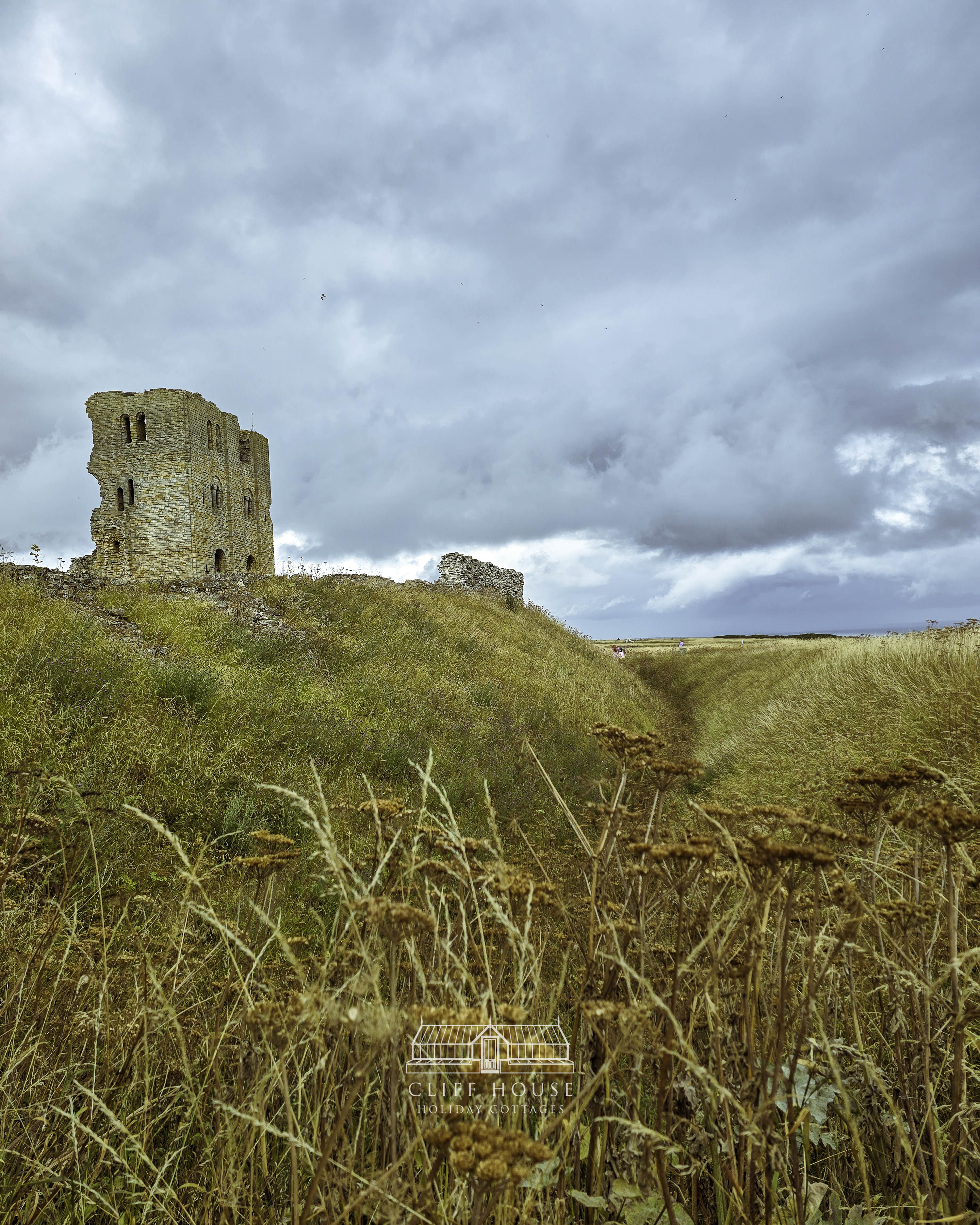
The castle was first established during the 12th century by William le Gros, Count of Aumâle. It later passed into royal hands, and Henry II began rebuilding it in stone in 1159. The great tower, which still dominates the site despite the damage it has suffered, was constructed between 1159 and 1169.
King John also played an important part in the castle’s development.
We had initially remembered this as John using the castle for nine years, but the full story is slightly different. He did not live at Scarborough Castle continuously for nine years. Instead, he visited several times and oversaw a major programme of building and strengthening work over roughly a decade.
Between 1202 and 1212, John spent £2,291 on Scarborough Castle, more than he spent on any other castle in his kingdom. The work included strengthening and extending the walls, constructing a hall within the inner bailey and adding a royal chamber block. The remains of that chamber block can still be seen today.
Scarborough and Knaresborough appear to have been developed as important royal strongholds from which John could maintain control over Yorkshire. Standing on the headland, it is easy to understand why Scarborough was so strategically valuable. The position offered commanding views over the harbour, the town and the surrounding coastline.
The Roman signal station
The history of the headland began long before the medieval castle.
At the seaward end of the site are the remains of a late fourth-century Roman signal station. It was probably one of a number of fortified towers positioned along the north-east coast of Britain.
Coins, pottery and similarities with other coastal sites suggest that the tower formed part of a wider Roman defensive network, although historians continue to debate exactly how the stations communicated and what threats they were intended to detect. The Scarborough station appears to have been abandoned during the early fifth century.
Later, a small chapel was built within the remains of the Roman station, and a burial ground developed around it. This small part of the headland therefore brings together Roman, medieval and religious history in one place.
Views across South Bay and the story of the spa
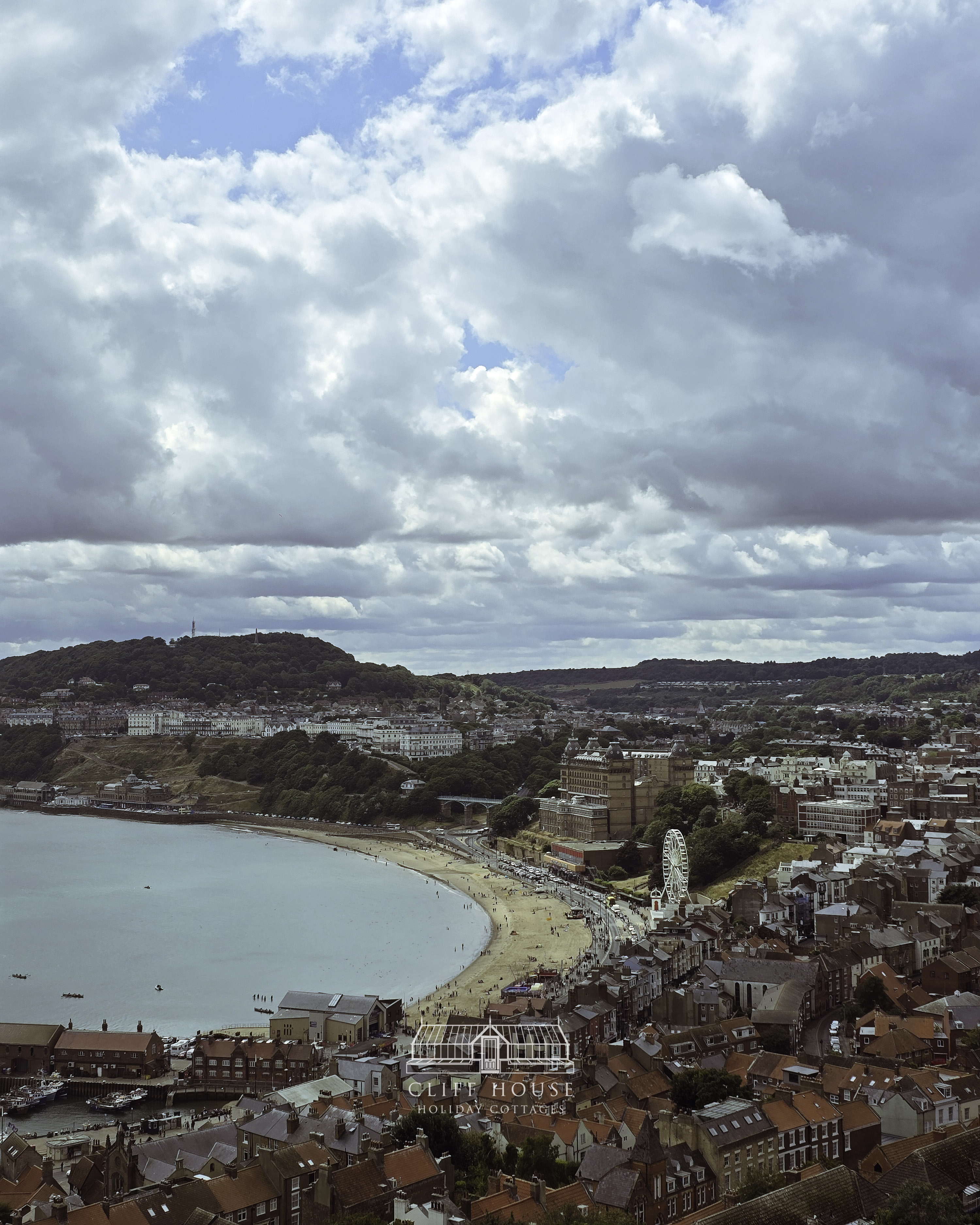
The elevated position of the castle gives you some of the best views in Scarborough.
Looking across South Bay, Roy explained how the discovery of mineral springs helped transform the town from a working port into one of Britain’s earliest seaside resorts.
Scarborough’s spa story began in 1626, when Thomasin Farrer discovered mineral springs beneath the cliffs near what is now Scarborough Spa. Visitors began travelling to the town to drink the waters, and Scarborough gradually developed into a fashionable health resort. In 2026, the town is marking 400 years since that discovery.
From the castle headland, you can see how the harbour, beach, spa and later resort developed around the natural shape of the bay.
The Civil War siege
The castle’s dramatic appearance owes much to the English Civil War.
Scarborough initially supported Parliament, but its governor, Sir Hugh Cholmley, later changed sides and declared for the king. The town and harbour then became an important Royalist base, with ships operating from Scarborough disrupting coal supplies travelling south.
In 1645, Parliamentarian forces captured the town and forced Cholmley and his men to retreat into the castle. What followed was a five-month siege, described by English Heritage as one of the bloodiest of the Civil War.
Parliamentarian soldiers occupied nearby St Mary’s Church. The east window of the medieval church was removed so that cannon could be positioned inside and fired towards the castle. The church itself suffered heavily when the Royalist defenders returned fire.
The bombardment caused enormous damage to the castle’s great tower. Its thick western wall split and collapsed, leaving the building without its floors, roof or battlements.
Cholmley’s garrison eventually ran out of gunpowder, money and food. The castle surrendered on 25 July 1645. It was besieged again in 1648, although opposition from the people of Scarborough helped prevent Parliament from completely destroying it.
Looking from the castle towards St Mary’s Church makes the story particularly vivid. The distance between the two is surprisingly short, and it is easy to imagine the exchange of cannon fire across the ground separating them.
Scarborough under German fire
Roy also pointed out damage associated with another attack on Scarborough, this time during the opening months of the First World War.
On the morning of 16 December 1914, two German warships opened fire on Scarborough from the North Sea. More than 500 shells were fired at the town and castle, causing deaths, injuries and widespread damage.
An 18th-century barracks block within the castle was badly damaged during the attack. When Scarborough Castle was taken into state guardianship in 1920, the remains of the barracks were demolished. Damage from the bombardment can still be identified around the site.
The attack demonstrated that Scarborough’s exposed coastal position, which had made the castle so valuable for centuries, could also leave the town vulnerable.
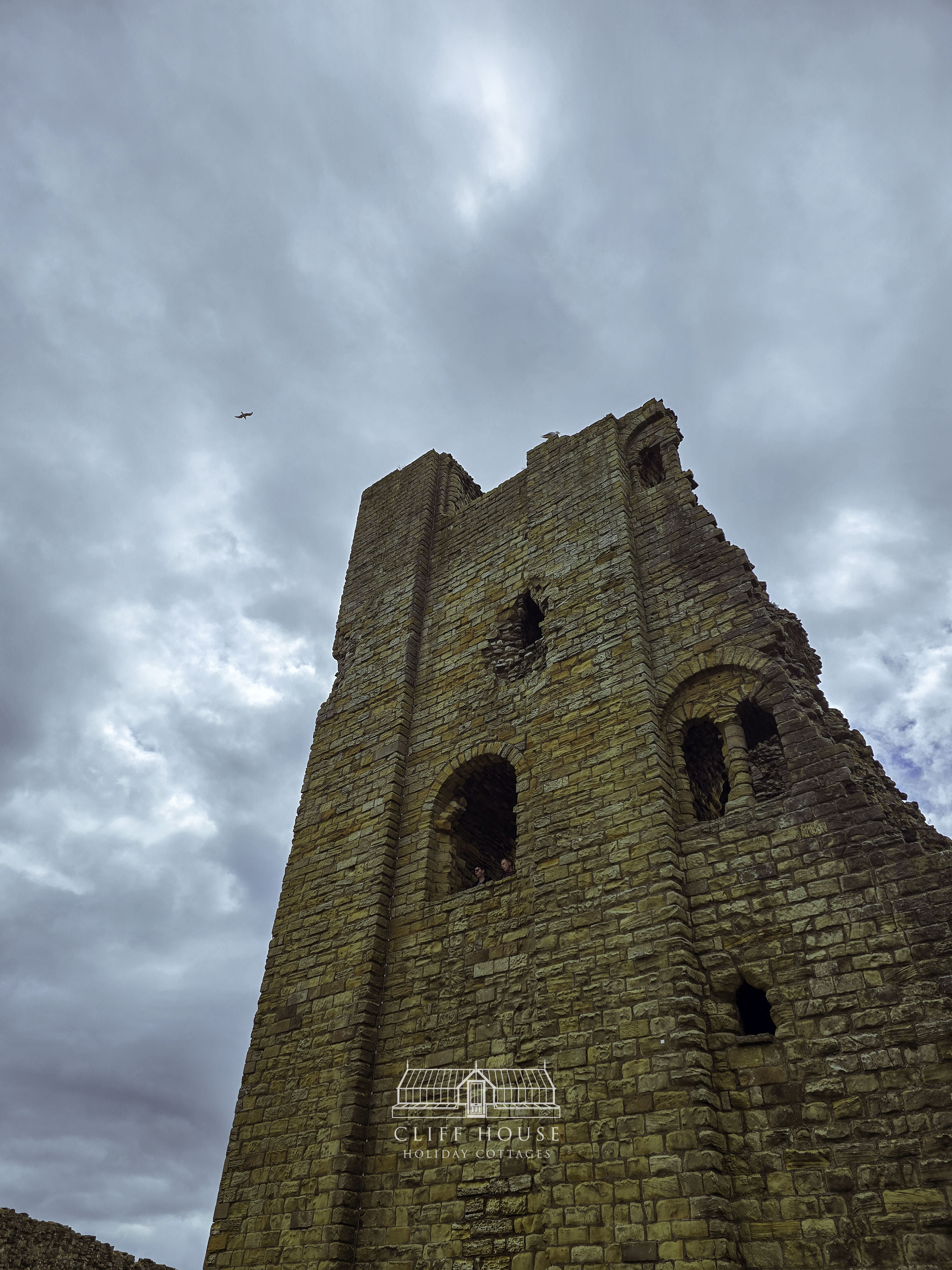
The damage by the Germans (a chunk out of the edge of the tower and a hole right through the wall)
Looking towards the lost North Bay Pier
From the other side of the headland, the tour took us through the more recent history of North Bay.
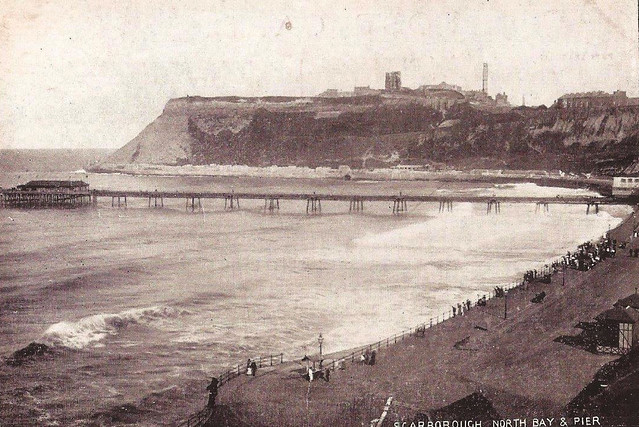
Roy showed us old images of Scarborough’s North Pier, which once extended into the bay below. The pier opened in May 1869 and became a popular promenade and landing place for pleasure steamers.
Its life was relatively brief. On 7 January 1905, a severe storm destroyed most of the structure and isolated the pavilion at its end. Further storms completed the destruction, and today very little evidence of the pier remains.
Without the photographs and Roy’s explanation, we would never have known it had been there.
More than a collection of ruins
After the tour, we stopped for coffee, cakes and ice cream before spending a little more time exploring the headland.
Scarborough Castle is much larger than it first appears from the town below. There is plenty of open space to walk around, as well as views across the harbour, both bays and the Yorkshire coast.
The visit also reinforced the value that volunteer guides bring to historic places. Roy’s knowledge and enthusiasm connected the surviving walls with the people, conflicts and events that shaped them.
Without the tour, we would have enjoyed the views and admired the ruins. With Roy’s help, we crossed medieval drawbridges, stood in King John’s royal castle, explored a Roman signal station and traced the scars left by the Civil War and the First World War.
A pint below the castle
After leaving the castle, we walked down into Scarborough’s Old Town and stopped at the Leeds Arms, just below the headland.
It is a traditional and very popular little pub. There is no food and there are no hot drinks, just a good choice of well-kept beer. After 90 minutes of history and a walk around the exposed headland, a pint was a fitting end to the visit.
Visiting Scarborough Castle from Cliff House
Visiting Scarborough Castle is easy from Cliff House as its around a 25-minute drive from Cliff House Holiday Cottages and can easily be combined with time in the Old Town, a walk around the harbour or a visit to St Mary’s Church.
Allow more time than you might expect. The site covers a substantial part of the headland, and the views alone encourage you to stop regularly.
For us, the guided tour transformed the experience. It revealed details we would otherwise have walked past and showed how the history of the castle is closely connected with the wider story of Scarborough.
From Roman lookouts and medieval kings to Civil War cannon and German warships, few places bring together so many different chapters of the Yorkshire coast’s history.